Bitcoin roulette: playing and cashing out in BTC, USDT and other coins
Where to play
Bitcoin roulette is ordinary roulette paid for in coins. The wheel is the same; what changes is the cashier. Here is how deposits, display currencies, networks, price swings and withdrawal caps work when your stake is crypto.
Bitcoin roulette is not a separate game. A roulette wheel, live or software, does exactly the same thing whether the chip on the layout stands for a dollar or for a thousand satoshis. What changes when you bring crypto is the part before and after the spin: how the money reaches the table, what currency the table counts in, and how it leaves again. That is also where most of the mistakes happen, so this page is about the cashier, not the wheel.
Which coin to bring to the table
Every casino on our crypto roulette casinos list takes bitcoin. Most also take ethereum, USDT and litecoin, and several go much further: Wolf.bet lists thirteen coins, Wild.io twelve, DuckDice and LTC Casino ten each. Which one you use matters more than it seems.
Bitcoin is the one everyone holds, but its price moves while you play. Imagine you deposit 0.01 BTC, play for an evening and finish 10% up at the table. If bitcoin fell 10% in the same evening, you are back where you started in dollar terms. The reverse happens too. For a roulette player who wants to judge a session by the result of the spins, that is noise.
USDT and USDC are dollar stablecoins: one coin is meant to stay at one dollar. A balance in USDT tells you exactly how the session went. That is why we quote stakes and wins in USDT across this site, and why the demo spin on our home page bets 10 USDT.
Litecoin, TRON, Solana and dogecoin are cheap and quick to send. They are useful if you move small amounts often, but they move in price just as bitcoin does.
Networks: the one mistake that loses coins
USDT is not one coin on one blockchain. It exists on Tron (TRC-20), Ethereum (ERC-20), BNB Chain and others, and the same is true for USDC. A deposit address belongs to one network. If you send USDT on Ethereum to an address the cashier generated for Tron, the coins may never arrive, and recovering them depends entirely on the casino's goodwill.
The rule is simple: in the cashier, pick the coin, then pick the network, then copy the address. In your wallet or exchange, choose the same network before you paste. The first time you use a casino, send a small amount and wait for it to land before sending the rest.

Display currency and table limits
Many crypto casinos hold your balance in the coin you deposited but show it converted into dollars or euros, and the table limits at live roulette are set in that display currency. A European table with a 0.20 minimum and a 2,000 maximum means 0.20 to 2,000 in the display currency, converted from your coin at the moment of each bet. If you prefer to see the real coin amount, most casinos let you switch the display off in the account settings.
This matters most for small balances. At a live table with a 1 USD minimum, a balance of 20 USDT gives you twenty bets at the minimum on an even-money chance. At 2.70% house edge per bet, you lose on average about 0.54 USDT over those twenty spins, but the swings are much bigger than that, which is why a sensible stake is a small fraction of the balance.
Withdrawing your winnings
A crypto withdrawal goes to a wallet address you enter. Before it leaves, the casino reviews it, and this review is where time goes, not on the blockchain. Three things decide how smooth it is:
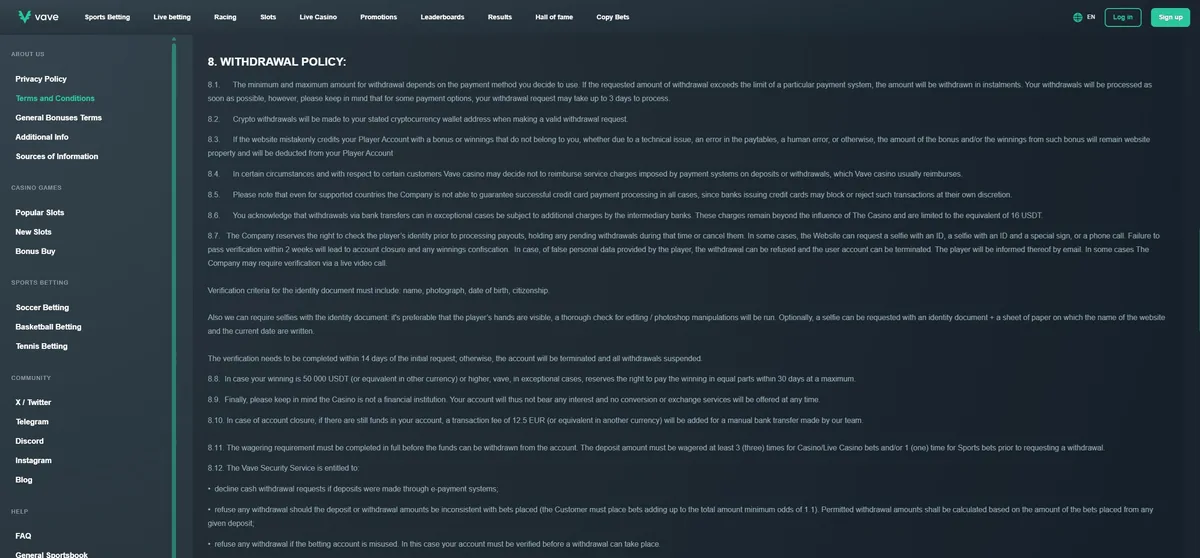
- Wagering on your deposit. Some casinos ask that a deposit be played through before it can be withdrawn. Vave's clause 8.11, for example, asks for the deposit to be wagered three times. Read this before you deposit if you might want to cash out early.
- An active bonus. While a bonus is running, a withdrawal usually waits until the wagering is done, or cancels the bonus.
- Identity checks. Every casino on our list keeps the right to ask for documents. Bitcasino.io names a threshold of 2,500 EUR; Vave's clause 8.7 allows a check before any payout and gives 14 days to comply. At Vave we withdrew twice, on 28 August and 2 September 2026, and were not asked.
Withdrawal caps for high rollers
Roulette invites big single bets, and a straight-up win at 35 to 1 turns a large stake into a very large balance at once. Before you play high, find the cap. On our list, Bitcasino.io allows up to 1,000,000 USDT a week (clause 6.10), Wild.io 100,000 USD a week (clause 9.6), BetPlays 5,000 EUR a week (clause 6.11). Vave pays wins of 50,000 USDT or more in instalments over 30 days (clause 8.8). A cap is not a trap if you know it in advance; it is a trap if you discover it after winning.
Where to play bitcoin roulette
Any casino in our ranking will take a bitcoin deposit and seat you at a roulette table. If you want dollar-stable play, pick one that lists USDT or USDC and check which networks it supports. If you want live tables, look at the studios each one names: Bitcasino.io lists six, BetFury and LTC Casino four. If you want the casino we have actually used with our own coins, that is Vave; the details are in our Vave review. For the live side of things, continue with live roulette with crypto.
Keeping score honestly
Crypto makes it easy to lose track: several coins, a display currency, a price that moves. Pick one unit and stick to it for the session. Write down what you deposited in that unit and what you withdrew. Set a deposit limit in the casino before your first spin, and remember that the 2.70% is charged on every bet, not on every deposit, so fast play costs more than slow play at the same stake.