Roulette strategy: what betting systems do, and the one thing they cannot
Playing it well
Every roulette system reshapes your results: more small wins and rarer big losses, or the reverse. None of them touches the house edge. Here is the maths of the popular ones, and the parts of a strategy that really help.
Roulette strategy is the most searched topic around the game, and most of what comes up promises more than maths allows. The honest summary fits in one line: a betting system changes the shape of your results, not their average. On a single-zero wheel you lose 2.70% of everything you stake, on average, whatever order you stake it in. With that in mind, systems are still worth understanding, because they differ a lot in how fast they can empty a balance.
Why no system beats the house edge
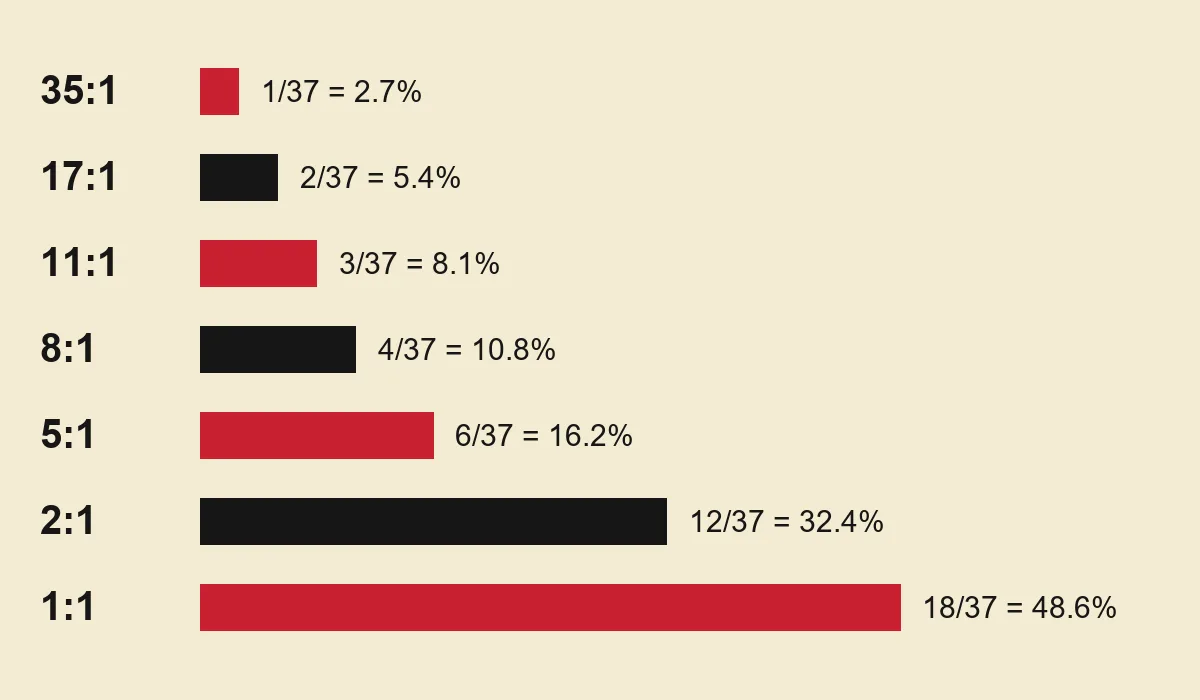
Take a bet on red. There are 18 red pockets out of 37. You win 1 unit with probability 18/37 and lose 1 unit with probability 19/37. The expected result per unit is 18/37 − 19/37 = −1/37, or −2.70%. Every bet on the table works out the same way. A system is only a rule for choosing the size of the next bet. Adding up many bets, each with an expected loss of 2.70% of its size, gives an expected loss of 2.70% of the total staked. No sequence of sizes can turn a sum of negative numbers into a positive one.
What a system can do is move the losses around: many small wins and one rare, large loss (Martingale), or many small losses and one rare, large win (Paroli). That is a real difference for how a session feels, and for how likely you are to walk away ahead from one session. It is not a difference in cost.
The Martingale
Double your stake after every loss, go back to the base stake after a win. When the win comes, it recovers all the losses in the run plus one base unit.
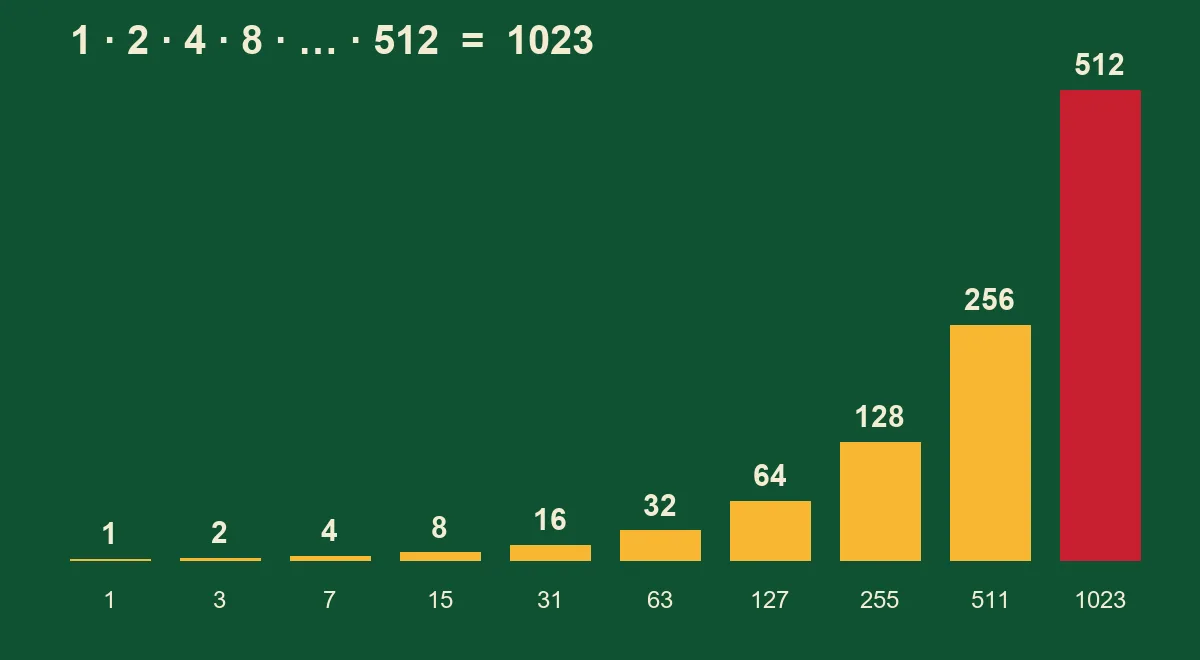
The catch is the length of a losing run. On an even-money bet on a single-zero wheel, the chance of losing ten in a row is (19/37)¹⁰, about 1 in 780. Over a long evening of several hundred spins, a run like that is not unusual. With a 1 USDT base, ten losses mean stakes of 1, 2, 4 and so on up to 512, a total of 1,023 USDT lost, and the next bet would have to be 1,024 USDT to win back 1 USDT. Most live tables cap the maximum on even chances well before that ratio, and most bankrolls end sooner.
D'Alembert and Fibonacci
The D'Alembert raises the stake by one unit after a loss and lowers it by one after a win. The curve is much flatter than the Martingale's, so losing runs hurt less, but a long run still grows the stake steadily and a win recovers less than the run cost.
The Fibonacci follows 1, 1, 2, 3, 5, 8, 13 and so on after each loss, and steps back two places after a win. It grows more slowly than doubling but still grows without limit. Both have exactly the same 2.70% cost per unit staked.
Labouchère and Paroli
The Labouchère writes a line of numbers (for example 1-2-3-4) and bets the sum of the first and last; a win crosses them out, a loss adds the stake to the end. It feels like a plan, and it breaks the same way as the others on a long run.
The Paroli is the reverse Martingale: double after a win, go back to base after a loss or after three wins in a row. You lose small amounts often and occasionally win a streak. It is the gentlest on a balance, because your own money is only ever the base stake; the rest is winnings riding on.
What a real roulette plan looks like
- Choose the cheapest table. Single zero, not double. French with la partage for even-money bets: 1.35% instead of 2.70%. See roulette odds and payouts for every number.
- Set a session budget and put it into the casino's own deposit limit before you play.
- Pick a stake from the budget, not from the last result. A stake of 1–2% of the session budget gives you a long session; 10% gives you a short one.
- Mind the speed. The edge is charged per bet. Fifty live spins an hour cost far less than five hundred software spins at the same stake.
- Set a stop in both directions. A loss limit and a win you want to keep. Leave when you reach either.
- Keep bonuses out of it unless you have read how roulette counts: many bonuses ban systems like the Martingale outright. Our page on roulette and casino bonuses explains what to look for.
Myths worth dropping
- ”Red is due.” The wheel has no memory. After ten blacks, red is still 18 in 37.
- ”Hot numbers.” A number that came up three times in fifty spins is a normal fluke, not a trend.
- ”Covering the table guarantees a win.” Covering 30 numbers wins often and loses the lot to the other 7; the average cost is the same 2.70%. Many bonus terms forbid it anyway.
- ”A system beat the casino for me last week.” That is the Martingale's shape at work: frequent small wins until the rare large loss.
If you want to see where a table is, choose from our list of crypto roulette casinos, and read how to play roulette if the layout is new to you.