Roulette odds and payouts: every bet, its chance and what it costs
The game
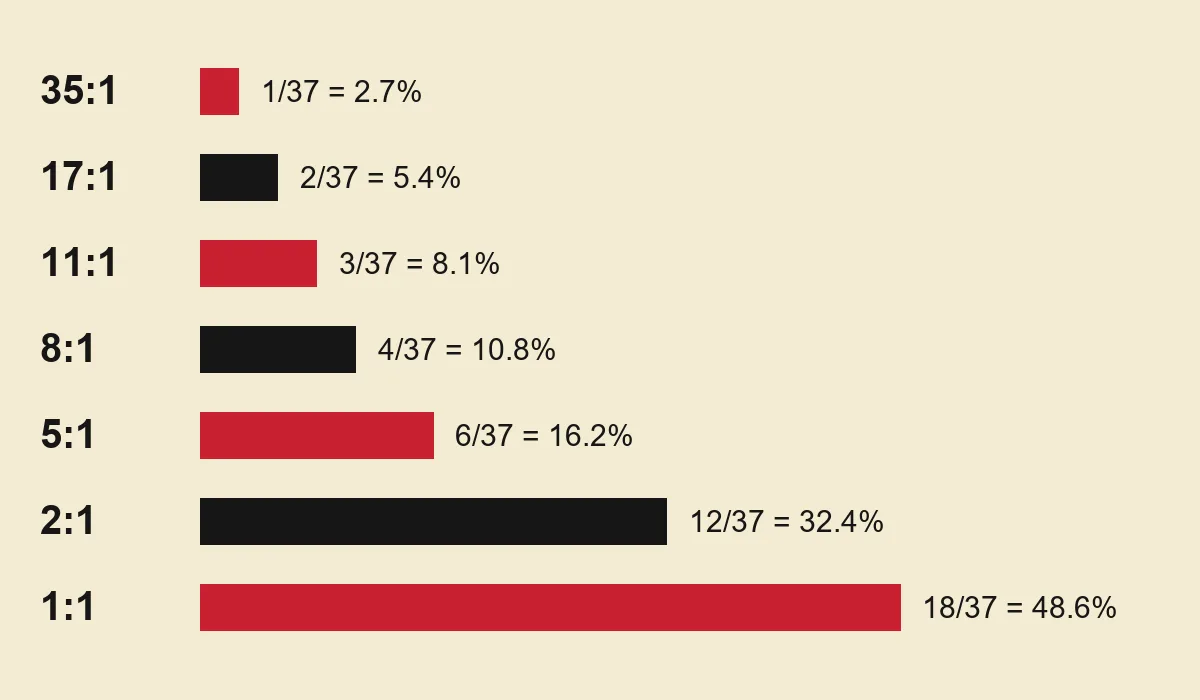
One chart answers most roulette questions: how much each bet pays, how often it wins, and how much the house keeps. Here it is for single-zero and double-zero wheels, with the maths behind the numbers.
Roulette odds and payouts are the same at every casino that uses a standard wheel, which makes them the one part of the game you can learn once and use everywhere. The chart below covers every standard bet. Two numbers matter for each: the payout, which is what the casino promises, and the chance, which is what the wheel delivers. The gap between them is the house edge.
The payout chart
| Bet | Numbers | Payout | Chance, single zero | Chance, double zero |
|---|---|---|---|---|
| Straight up | 1 | 35:1 | 2.70% | 2.63% |
| Split | 2 | 17:1 | 5.41% | 5.26% |
| Street | 3 | 11:1 | 8.11% | 7.89% |
| Corner | 4 | 8:1 | 10.81% | 10.53% |
| Five-number (0, 00, 1, 2, 3) | 5 | 6:1 | — | 13.16% |
| Six line | 6 | 5:1 | 16.22% | 15.79% |
| Dozen / column | 12 | 2:1 | 32.43% | 31.58% |
| Red, black, odd, even, 1–18, 19–36 | 18 | 1:1 | 48.65% | 47.37% |
Where the house edge comes from
A fair payout would pay you back exactly what the odds deserve. A single number has one chance in 37, so a fair payout would be 36 to 1. The casino pays 35 to 1. Over 37 spins with 1 unit on one number, you expect to win once (35 units plus your stake back) and lose 36 times: 35 − 36 = −1 unit over 37 units staked, or −2.70%.
Every bet on a single-zero table is priced so that the same 1 unit in 37 goes to the house. A split pays 17:1 where fair would be 17.5:1; a dozen pays 2:1 where fair would be 2.083:1; red pays 1:1 where fair would need 18.5 red pockets. That is why no bet is “better” than another on value, only different in how often it wins and how much.
Single zero against double zero
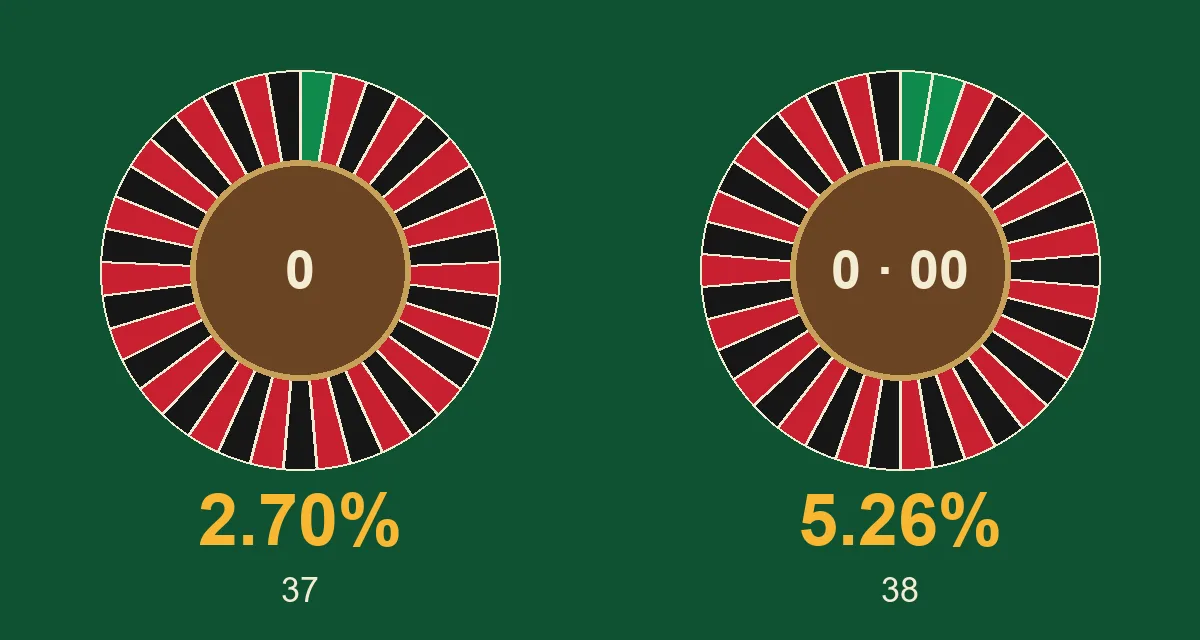
The double-zero wheel adds one pocket and keeps the same payouts. Now 35:1 is paid on a 1 in 38 chance, and the house keeps 2 units in 38, or 5.26%. The five-number bet, only possible on the double-zero layout, pays 6:1 on 5 chances in 38 and costs 7.89%, the worst bet on any standard table.
French rules: la partage and en prison
On French tables, when zero comes up and you have an even-money bet on the table, you lose only half of it (la partage), or the bet is held for the next spin (en prison). Both cut the house edge on even-money bets in half, to 1.35%. They do not apply to inside bets, dozens or columns, which stay at 2.70%. For a player who likes red and black, a French table is the cheapest seat in the casino.
Payouts in practice, with crypto stakes
With 10 USDT on each type of bet, a win returns:
- straight up: 350 USDT won, 360 back in total;
- split: 170 won;
- street: 110 won;
- corner: 80 won;
- six line: 50 won;
- dozen or column: 20 won;
- red or black: 10 won.
Over a long run, each of those bets costs the same 0.27 USDT per 10 USDT staked on a single-zero wheel. The difference is only in the swings: the straight-up player wins rarely and big, the red player often and small.
Side rules that change the numbers
Some tables change the payouts and so the edge. Lightning Roulette pays 29:1 on straight-up wins without a multiplier, and 50 to 500 times on the few lucky numbers each round; its published return is around 97.10%. Double Ball Roulette and other variants have their own tables printed in the game's info panel. When a table is not a plain European or French wheel, open the info panel and read the payouts before you bet.
To use these numbers in a plan, go to roulette strategy. To see where to play at single-zero tables with crypto, go back to our list of crypto roulette casinos. If the names of the bets are new, start with how to play roulette.